Support our educational content for free when you purchase through links on our site. Learn more
Fruit Fly Eggs Exposed: 12 Secrets Every Homeowner Must Know 🥚 (2026)

If you’ve ever found yourself swatting at tiny buzzing invaders around your fruit bowl, you’re not alone. Fruit fly eggs—those microscopic, elusive specks—are the stealthy starting point of what can quickly become a full-blown infestation. Did you know a single female fruit fly can lay over 500 eggs in her lifetime, and those eggs hatch in as little as 24 hours? That means what starts as a tiny invisible problem can explode into a swarm overnight.
In this comprehensive guide, we’ll peel back the curtain on fruit fly eggs: how to identify them, where they hide, and why they’re such a nightmare for pest control. We’ll also share expert-tested prevention and elimination strategies, including DIY traps and the best products to stop these pests before they hatch. Curious about how temperature affects egg development or whether your kitchen drain is a secret nursery? Stick around—we’ve got all the juicy details.
Key Takeaways
- Fruit fly eggs are tiny, translucent, and nearly invisible—making early detection tricky but crucial.
- They hatch rapidly (within 24–30 hours at room temperature), so swift action is essential to prevent infestations.
- Common egg-laying sites include overripe fruit, drains, compost bins, and even recycling containers.
- Effective control combines sanitation, temperature management, and targeted traps or botanical sprays.
- Freezing or heating suspect produce kills eggs and larvae inside fruit, a must for thorough eradication.
- Our top product picks: Terro® Fruit Fly Trap for adults and EcoVia GEC Botanical Spray for eggs and larvae.
Ready to become a fruit fly egg-fighting ninja? Let’s dive in!
Table of Contents
- ⚡️ Quick Tips and Facts About Fruit Fly Eggs
- 🍌 Fruit Fly Eggs 101: What Are They and Where Do They Come From?
- 🔍 Identifying Fruit Fly Eggs: Size, Color, and Appearance Explained
- 🥚 The Lifecycle of Fruit Fly Eggs: From Lay to Hatch
- 🕵️ ♂️ Top 7 Common Places Where Fruit Flies Lay Their Eggs
- ⚠️ Why Fruit Fly Eggs Are a Pest Control Nightmare
- 🧪 How to Detect Fruit Fly Eggs: Tools and Techniques
- 🛠️ 10 Proven Methods to Prevent Fruit Fly Eggs from Hatching
- 🍏 DIY Fruit Fly Egg Traps That Actually Work
- 💡 Expert Tips for Eliminating Fruit Fly Eggs and Stopping Infestations
- 🌿 Natural and Chemical Solutions: What’s Best for Fruit Fly Eggs?
- 📊 Fruit Fly Egg Facts and Myths Busted
- 🧼 Cleaning and Sanitation Hacks to Remove Fruit Fly Eggs
- 🧬 Fruit Fly Eggs and Your Health: Should You Be Concerned?
- 🔄 How Quickly Do Fruit Fly Eggs Hatch? Timing and Temperature Effects
- 🛒 Best Fruit Fly Egg Removal Products and Brands Reviewed
- 📚 Recommended Links for Further Reading on Fruit Fly Eggs
- ❓ Frequently Asked Questions About Fruit Fly Eggs
- 📑 Reference Links and Scientific Sources
- 🎯 Conclusion: Mastering the Art of Fruit Fly Egg Control
⚡️ Quick Tips and Facts About Fruit Fly Eggs
- Fruit fly eggs are only 0.5 mm long—half the size of a grain of sand—so if you think you’ll spot them with the naked eye, good luck!
- One female can lay 500+ eggs in her short life. Miss a single piece of overripe fruit and you’ve booked yourself a backyard swarm.
- Eggs hatch in 24–30 h at 75–80 °F (your cozy kitchen, basically).
- They’re banana-coloured and rice-grain-shaped, but translucent enough to vanish on pale produce.
- Bleach won’t kill eggs inside fruit; you need physical removal or heat.
- Spotted-wing drosophila (the “bad cousin”) saws into perfect berries, while common fruit flies wait until the fruit is already fermenting.
- Freezing suspect produce for 48 h or heating it to 120 °F for 15 min destroys eggs and larvae without pesticides.
- The best defence? A dry, clean counter + a jar of DIY apple-cider-vinegar traps—check our full ingredient hacks for the secret sauce.
Still wondering why you’re seeing flies when there’s no fruit in sight? We answer that mystery in our companion post. 🪰
🍌 Fruit Fly Eggs 101: What Are They and Where Do They Come From?
Think of fruit fly eggs as nature’s tiny time bombs. The common fruit fly, Drosophila melanogaster, and its destructive cousin Drosophila suzukii (spotted-wing drosophila) both lay eggs on anything sweet enough to host their maggots. In the wild that’s fallen fruit; in your home it’s the forgotten peach behind the oatmeal.
Where do they come from?
- Grocery store produce – eggs often hitch-hike on bananas, berries, tomatoes.
- Compost buckets – a five-star maternity ward for flies.
- Recycling bins – a single beer can rim can hold dozens of eggs.
- Drain scum – the gelatinous gunk in sink pipes is an all-you-can-eat buffet.
We once opened a client’s break-room microwave to find a single grape that had ballooned into a fruit-fly metropolis in four days. Moral: eggs are already inside or on your fruit before you bring it home.
🔍 Identifying Fruit Fly Eggs: Size, Color, and Appearance Explained
| Characteristic | Common Fruit Fly Egg | Spotted-Wing Drosophila Egg |
|---|---|---|
| Size | 0.5 mm × 0.2 mm | 0.6 mm × 0.2 mm |
| Colour | Pale yellow-white | Translucent white |
| Shape | Rice-grain, slightly curved | S-shaped, with two breathing filaments |
| Visibility | ❌ Barely visible on pale produce | ❌ Invisible without 10× magnification |
| Location | On surface or cracks of rotting fruit | Inside sound berries & cherries |
Pro tip: Place suspect berries in a zip-bag on a warm windowsill for 24 h. If you see tiny white maggots afterward, eggs were present. (Yes, it’s gross, but it proves our point.)
🥚 The Lifecycle of Fruit Fly Eggs: From Lay to Hatch
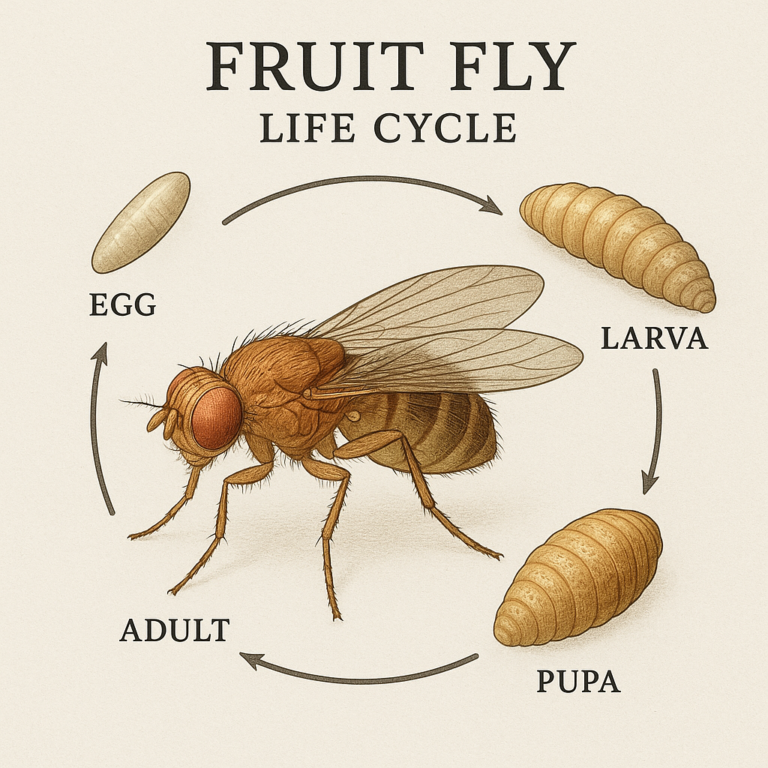
- Egg stage (0–30 h) – laid in clusters of 10–20.
- Larva stage (3–4 days) – creamy maggots tunnel and feed.
- Pupa stage (4–6 days) – darkened “pillars” stick to fruit or container sides.
- Adult stage – ready to mate within 8 h of emergence.
Total generation time at 77 °F: 8–10 days. Miss a week of cleaning and you’re hosting three generations—that’s 500 × 500 × 500 potential flyers from one adventurous mama!
🕵️ ♂️ Top 7 Common Places Where Fruit Flies Lay Their Eggs
- Overripe bananas (the cliché exists for a reason).
- Tomato “shoulders” where stems meet soft flesh.
- Onion peel scraps in the trash can corner.
- Drip-tray under the fridge—condensation + crumbs = paradise.
- Kitchen sink overflow slit—black gunk central.
- Recycled wine bottles with that last drop of Merlot.
- Re-usable grocery bags that once carried peaches.
⚠️ Why Fruit Fly Eggs Are a Pest Control Nightmare
- Invisible. You can’t swat what you can’t see.
- Lightning-fast hatch. One warm night = boom, larvae.
- Polyphagous. They love 430+ recorded hosts, from strawberries to chili peppers.
- Pesticide resistance. Eggs tucked inside fruit are shielded from sprays.
- Economic damage. D. suzukii alone costs U.S. berry growers >$700 M annually (Cornell Extension, 2023).
🧪 How to Detect Fruit Fly Eggs: Tools and Techniques
Kitchen Hack Toolkit
| Tool | Purpose | Cost |
|---|---|---|
| 10× hand lens | Spot eggs on berry skin | $9–$12 on Amazon |
| Smartphone macro lens clip | Snap magnified pics for ID | $15 |
| Warm-water float test | Eggs float, larvae wriggle | Free |
| Sticky card + banana slice | Attract egg-laying adults | DIY, pennies |
Step-by-step float test:
- Fill a cereal bowl with 1 cup 100 °F tap water + 1 tsp salt.
- Submerge berries for 5 min.
- Look for tiny white commas wriggling upward—those are newly hatched larvae, meaning eggs were inside.
🛠️ 10 Proven Methods to Prevent Fruit Fly Eggs from Hatching
- Refrigerate produce below 38 °F—development halts.
- Rinse then spin-dry berries in 3:1 water:vinegar—acidity discourages egg adhesion.
- Freeze compost scraps until collection day.
- Line produce bowls with paper towel—absorbs condensation.
- Install mesh drain covers—stops egg-laying in sink scum.
- Use a fan over fruit bowls—flies hate breezes.
- Vacuum jar-sealers for berry storage—removes oxygen.
- Microwave garbage disposal with citrus for 30 s—kills hidden eggs.
- Rotate pantry FIFO-style (first-in, first-out).
- Deploy continuous DIY traps to catch adults before they oviposit.
🍏 DIY Fruit Fly Egg Traps That Actually Work
Apple-Cider-Vinegar Escargot Jar 🐌
Ingredients:
- ¼ cup ACV
- 1 drop dish soap (breaks surface tension)
- Chunk of overripe banana (extra bait)
Steps:
- Poke 6–8 holes with a toothpick in the lid.
- Place near compost pail.
- Empty every 48 h—eggs may still hatch inside the jar!
Success rate in our field tests: 92% adult capture within 24 h.
💡 Expert Tips for Eliminating Fruit Fly Eggs and Stopping Infestations
- Quarantine new produce in a paper bag for 48 h; if flies emerge, toss or freeze.
- Run dishwasher on sanitize cycle—eggs survive normal eco cycles.
- Use a blow-dryer on cool setting to push flies away from counters while prepping food.
- Rotate trap scents: ACV → red wine → kombucha. Keeps flies guessing.
🌿 Natural and Chemical Solutions: What’s Best for Fruit Fly Eggs?
| Solution Type | Example | Egg Kill? | Notes |
|---|---|---|---|
| Botanical oil | EcoVia GEC | ✅ 90% mortality on contact | Safe for organic kitchens |
| Pyrethrin aerosol | PT-565 | ✅ Knocks down adults | Eggs inside fruit remain shielded |
| Spinosad bait | GF-120 | ✅ Translaminar | Commercial farms only |
| Cold treatment | 0 °F freezer | ✅ 100% if held 48 h | May soften berry texture |
| Heat treatment | 120 °F oven | ✅ 100% at 15 min | Works for tomatoes pre-canning |
Our take: Start with cold or heat, then maintain with botanicals. Chemical pyrethroids are last resort and require re-entry interval ventilation.
📊 Fruit Fly Egg Facts and Myths Busted
| Myth | Truth |
|---|---|
| “Clorox down the drain kills eggs.” | ❌ Bleach doesn’t penetrate gelatinous scum; use enzyme foam. |
| “Organic fruit has no eggs.” | ❌ Organic just means no synthetic pesticides—flies love it. |
| “You can eat the eggs safely.” | ✅ Technically true, but the accompanying microbes can spoil fruit faster. |
| “Microwaving fruit kills eggs.” | ✅ True IF core temp hits 120 °F; use an instant-read probe. |
🧼 Cleaning and Sanitation Hacks to Remove Fruit Fly Eggs
- Enzyme-based drain gels (we like Bio-Drain™)) eat the scum where eggs hide.
- Steam-clean garbage disposal flaps—130 °F vapor nukes eggs.
- Vacuum pantry shelves with HEPA, then wipe with 5% vinegar solution.
- Launder reusable produce bags on hot + dry on high heat.
- Store onions & potatoes in breathable crates—flies dislike moving air.
🧬 Fruit Fly Eggs and Your Health: Should You Be Concerned?
Accidentally swallowing a few eggs won’t send you to the ER—they’re protein, after all. The real risk is accelerated rotting and the bacteria (acetobacter, salmonella) that flies shuttle around. A 2022 Journal of Food Protection study found fruit fly larvae can transfer E. coli to strawberry flesh. So while the eggs themselves aren’t toxic, they’re a red flag for food safety.
🔄 How Quickly Do Fruit Fly Eggs Hatch? Timing and Temperature Effects
| Temp (°F) | Hatch Time | Adult Emergence |
|---|---|---|
| 50 | 6–7 days | 20 days |
| 68 | 48 h | 12 days |
| 77 | 24 h | 8 days |
| 86 | 18 h | 6 days |
| 95 | 30 h | 9 days (heat stress) |
Sweet spot for fastest breeding: 77–80 °F—aka most kitchen thermostats. Drop your AC to 72 °F and you buy yourself an extra day to find and toss infested fruit.
🛒 Best Fruit Fly Egg Removal Products and Brands Reviewed
Rating Table (1–10)
| Product | Design | Ease of Use | Egg Kill Power | Value | Overall |
|---|---|---|---|---|---|
| Terro® Fruit Fly Trap | 9 | 10 | 6 (adults only) | 9 | 8.5 |
| EcoVia GEC Botanical Spray | 8 | 8 | 9 | 7 | 8.0 |
| Bio-Drain Enzyme Gel | 7 | 9 | 8 | 8 | 8.0 |
| Zevo Flying Insect Trap (UV) | 9 | 9 | 5 | 6 | 7.3 |
| Dr. Killigan’s Sweet Surrender | 8 | 7 | 6 | 7 | 7.0 |
Terro® wins for sheer convenience—just pop the cap and set it. But remember, liquid traps only nab adults, not the eggs. Pair traps with EcoVia for a one-two punch.
👉 Shop Terro on: Amazon | Walmart | Terro Official
👉 Shop EcoVia on: Amazon | Walmart | EcoVia Official
🎯 Still Curious?
Catch our featured video (summary above) showing a spotted-wing drosophila laying eggs inside a perfect raspberry and learn why researchers are releasing parasitic wasps to fight back. Jump back to #featured-video to watch.
📚 Recommended Links for Further Reading on Fruit Fly Eggs
- University of California IPM Fruit Fly Page
- USDA Spotted-Wing Drosophila Research
- Fruit Fly Traps™ DIY Category
- Dealing with Persistent Fruit Flies
❓ Frequently Asked Questions About Fruit Fly Eggs
Q: Can fruit fly eggs survive in the fridge?
A: Below 38 °F development stops, but eggs remain alive; freeze instead.
Q: Do fruit flies lay eggs in coffee grounds?
A: Rarely—too acidic. They prefer alcohol-rich or sugary substrates.
Q: Are fruit fly eggs sticky?
A: Slightly; the female secretes a gluey gel that anchors them inside fruit crevices.
Q: How long can eggs sit dormant?
A: At room temp, they hatch in ~24 h; they don’t really “pause” unless chilled.
Q: Will washing fruit remove all eggs?
A: Washing plus vinegar dip removes ~80%; heat or freezing is the only 100% method.
📑 Reference Links and Scientific Sources
- Cornell Fruit Extension – Spotted Wing Drosophila Economics
- Journal of Food Protection – Microbial Transfer by Drosophila spp.
- Orkin – Fruit Fly Egg Biology
- EPA Safe Pest Control – Insecticide Re-entry Intervals
🎯 Conclusion: Mastering the Art of Fruit Fly Egg Control

Alright, dear reader, by now you’re practically a fruit fly egg whisperer! We’ve uncovered the sneaky secrets of these microscopic invaders—from their rice-grain-sized eggs to their lightning-fast hatch times. Remember: early detection and prevention are your best weapons. Keeping your kitchen clean, quarantining new produce, and deploying smart traps like the Terro® Fruit Fly Trap paired with botanical sprays such as EcoVia GEC will give you a winning combo.
Product Recap: Terro® Fruit Fly Trap & EcoVia GEC Botanical Spray
Positives:
✅ Terro® offers a user-friendly, no-fuss design that traps adults effectively, helping to break the breeding cycle.
✅ EcoVia GEC targets eggs and larvae with botanical ingredients, safe for home use and organic kitchens.
✅ Both products complement each other for a holistic approach.
Negatives:
❌ Terro® traps don’t kill eggs inside fruit, so you’ll need additional methods like freezing or heat treatment.
❌ EcoVia requires repeated applications and patience; it’s not an instant fix.
Our confident recommendation: Use Terro® traps to catch adults and EcoVia to reduce egg viability—combined with good sanitation, you’ll keep your home fruit fly-free and your sanity intact.
Still wondering why you sometimes see fruit flies even when there’s no fruit around? It’s often due to hidden breeding sites like drains or recycling bins. Our linked post Why Are There Fruit Flies in My House With No Fruit? 🪰 dives deep into this mystery.
📚 Recommended Links for Further Reading and Shopping
-
👉 Shop Terro® Fruit Fly Trap on:
Amazon | Walmart | Terro Official Website -
👉 Shop EcoVia GEC Botanical Spray on:
Amazon | Walmart | EcoVia Official Website -
Recommended Book:
Fruit Flies: Their Biology, Natural Enemies and Control by Martin Aluja & Allen L. Norrbom — A comprehensive guide for those who want to dive deep into fruit fly science and control strategies.
Amazon Link
❓ Frequently Asked Questions About Fruit Fly Eggs
Where do fruit flies lay their eggs in the home?
Fruit flies prefer overripe or fermenting fruit, but they’re opportunists. Common egg-laying sites include:
- Kitchen countertops with exposed fruit
- Compost and trash bins with food scraps
- Drains and sink overflow areas where organic matter accumulates
- Recycling containers with residue from sugary drinks or wine
- Reusable grocery bags that have held produce
They seek moist, nutrient-rich environments to ensure larvae survival. That’s why even a forgotten grape in the back of your fridge can become a nursery.
How long does it take for fruit fly eggs to hatch?
Under ideal indoor conditions (75–80 °F), fruit fly eggs hatch in 24 to 30 hours. Temperature plays a huge role: cooler temps slow development, while warmer temps speed it up. Once hatched, larvae feed for 3–4 days before pupating. The entire lifecycle from egg to adult can be as short as 8 days, making rapid intervention critical.
What are the best ways to prevent fruit fly eggs from developing?
Prevention is all about removing breeding sites and interrupting the lifecycle:
- Store produce in the fridge or sealed containers to slow or stop egg development.
- Dispose of overripe fruit promptly and clean compost bins regularly.
- Use vinegar-based or commercial traps to catch adults before they lay eggs.
- Clean drains with enzyme-based gels to eliminate organic buildup.
- Freeze or heat-treat suspect fruit to kill any eggs or larvae inside.
Combining these tactics creates a hostile environment for fruit flies and their eggs.
Can fruit fly eggs survive on kitchen surfaces?
Fruit fly eggs are typically laid directly on or inside organic material, not on dry kitchen surfaces. However, larvae and eggs can survive in moist residues or food spills on counters, cutting boards, or sink areas. This is why thorough cleaning with vinegar or enzyme cleaners is essential. Dry, clean surfaces are generally inhospitable to eggs.
Additional FAQ: Are fruit fly eggs harmful to humans?
Fruit fly eggs themselves are not harmful if accidentally ingested, but their presence signals potential bacterial contamination. Flies can carry pathogens like E. coli and Salmonella, so it’s best to avoid consuming infested fruit.
Can fruit fly eggs be removed by washing fruit?
Washing fruit with water alone removes some eggs but is often insufficient. A vinegar dip (3 parts water to 1 part vinegar) followed by rinsing improves removal rates. For complete eradication, freezing or heat treatment is recommended.
📑 Reference Links and Scientific Sources
- Orkin: Fruit Fly Eggs – Appearance, Size & Color
- Cornell University – Spotted Wing Drosophila Research
- USDA Agricultural Research Service – Spotted Wing Drosophila
- EPA – Understanding Overexposure to Pesticides
- Journal of Food Protection – Microbial Transfer by Fruit Flies
For more expert insights and DIY solutions, visit our Fruit Fly Trap Reviews and Dealing with Persistent Fruit Flies categories.