Support our educational content for free when you purchase through links on our site. Learn more
🚫 Banish Fruit Flies in 24 Hours: The Ultimate 2026 Guide

The fastest way to how to get rid of fruit flies in the house is to immediately remove all fermenting food sources, set up apple cider vinegar traps with dish soap, and scrub your drains with boiling water. You don’t need expensive chemicals or a degree in entomology to win this war; you just need to understand that these pests reproduce at a terrifying speed, turning a single overlooked banana into a swarm of hundreds in less than 48 hours.
We once walked into a client’s pristine kitchen that smelled faintly of roting peaches, only to find a “cloud” of flies hovering over a single, unnoticed drop of spilled wine under the toaster. They had tried everything from bug sprays to ultrasonic repellers, but the infestation only grew because they ignored the larvae hiding in the drain biofilm.
It turns out, a single female fruit fly can lay up to 50 eggs in her short lifespan, and those eggs hatch in as little as 24 hours. This biological clock is why traditional cleaning often fails; you are fighting a war on two fronts: the adults you see and the invisible army waiting to emerge.
Key Takeaways
- Act Immediately: A single female can lay hundreds of eggs, so remove all food sources and set traps within hours of spotting the first fly.
- Target the Source: Apple cider vinegar mixed with dish soap is the most effective DIY lure, but you must also clean your drains to kill hidden larvae.
- Identify Correctly: Ensure you aren’t fighting fungus gnats (from plants) or drain flies (from pipes), as they require different treatments.
- Prevent Reinfestation: Store ripe fruit in the fridge, seal trash cans tightly, and rinse recycling bins regularly to break the breeding cycle.
Table of Contents
- ⚡️ Quick Tips and Facts
- 🕰️ The Uninvited History: Where Do Fruit Flies Come From?
- 🔍 Identifying the Enemy: Fruit Flies vs. Drain Flies vs. Fungus Gnats
- 🚫 The 7-Step Battle Plan: How to Get Rid of Fruit Flies in the House Fast
- 1. Locate and Eliminate the Breding Grounds
- 2. The Apple Cider Vinegar Trap: Why It Works Best
- 3. DIY Traps vs. Store-Bought Solutions: What Actually Catches Them
- 4. Deep Cleaning Your Drains to Stop the Cycle
- 5. Sanitizing Countertops and Removing Atractants
- 6. The Vacuum Cleaner Tactic for Adult Flies
- 7. Preventing Reinfestation: Long-Term Defense Strategies
- 🧪 The Science of the Swarm: Understanding Their Life Cycle
- 🏠 Kitchen-Specific Strategies: Banas, Trash Cans, and Compost Bins
- 🚿 Bathroom and Basement Frontiers: Tackling Hidden Breding Sites
- 🌿 Natural Remedies and Essential Oils: Do They Really Work?
- 🛒 Top-Rated Products We Trust: From Sticky Traps to Ultrasonic Repellents
- ❓ Frequently Asked Questions About Fruit Fly Infestations
- 🔗 Recommended Links and Resources
- 📚 Reference Links and Scientific Studies
- 🏁 Conclusion: Reclaiming Your Kitchen from the Tiny Tyrants
⚡️ Quick Tips and Facts
Before we grab our magnifying glasses and start the war, let’s hit the brakes and get the lowdown on what we’re dealing with. You might think you’re fighting a battle against a few annoying buzzers, but you’re actually up against a biological machine designed to reproduce at warp speed.
Here is the rapid-fire intel from our team at Fruit Fly Traps™:
- Speed is Key: A single female fruit fly can lay up to 50 eggs in her lifetime. Those eggs hatch in 24 to 30 hours. If you ignore them for a weekend, you aren’t just dealing with the flies you see; you’re dealing with their grandchildren.
- The “Magic” Ingredient: Apple Cider Vinegar (ACV) is the undisputed king of lures. Why? Because it smells like fermenting fruit, which is their version of a five-star buffet. Distilled white vinegar? ❌ It’s too sharp and often repels them.
- The Soap Secret: Adding a drop of dish soap to your trap breaks the surface tension. Without it, flies can land on the liquid, drink their fill, and fly away. With it? Splat. They sink immediately.
- It’s Not Just Fruit: While they love bananas, they are equally obsessed with fermenting beer, wine, spilled soda, and even the gunk inside your garbage disposal.
- The “Ghost” Infestation: If you clean everything and they still appear, check your drains. The larvae might be living in the biofilm inside your pipes, invisible to the naked eye until they emerge as adults.
Did you know? Fruit flies can detect the scent of roting fruit from miles away. No, really. Their olfactory system is so sensitive that a single molecule of fermentation can trigger a feeding frenzy. Learn more about fruit fly sensory capabilities here.
If you’re wondering why your pristine kitchen suddenly looks like a scene from a horror movie, it’s likely because you brought home a “Trojan Horse” from the grocery store. Read our deep dive on how infestations start here.
🕰️ The Uninvited History: Where Do Fruit Flies Come From?

Let’s take a trip back in time, shall we? The fruit fly (Drosophila melanogaster) isn’t some modern invention of the 21st-century supermarket. These little guys have been around for millions of years, evolving alongside the fermentation of fruits long before humans invented wine or kombucha.
The Evolutionary Survivalist
Historically, fruit flies were nature’s recyclers. They broke down decaying organic matter, returning nutrients to the soil. Fast forward today, and they’ve adapted perfectly to the human environment. They hitchike on produce, travel in shipping containers, and wait for the perfect moment to strike.
As the editors at Bon Appétit noted in their testing, “Fruit flies don’t appear out of nowhere… If they find an adequate food source in your kitchen, they’re more than happy to set up camp.” This quote perfectly encapsulates the opportunistic nature of these pests. They aren’t invading; they’re responding to an invitation you didn’t realize you sent.
The Modern Migration
How do they get into your home?
- The Grocery Store Hitchiker: You buy a bag of peaches. One has a tiny bruise. A female fly laid an egg on that bruise. You bring it home, and boom, the egg hatches.
- The Open Window: Adult flies can fly through the smallest gaps in window screens.
- The Drain Reservoir: If your home has old plumbing or infrequent use of a sink, larvae can establish a colony in the pipe slime.
Understanding this history helps us realize that prevention is just as important as elimination. You can’t just kill the adults; you have to cut off the supply line.
🔍 Identifying the Enemy: Fruit Flies vs. Drain Flies vs. Fungus Gnats
One of the biggest mistakes homeowners make is misidentifying their pest. You might be scrubing your drains with bleach, only to find the “fruit flies” are actually fungus gnats from your houseplants, or drain flies from a clogged pipe.
Let’s break down the differences so you don’t waste your time (and money) on the wrong solution.
| Feature | Fruit Fly (Drosophila) | Drain Fly (Psychodidae) | Fungus Gnat (Sciaridae) |
|---|---|---|---|
| Appearance | Small, tan/brown, red eyes. | Larger, fuzzy, moth-like, V-shaped wings. | Tiny, black, mosquito-like, long legs. |
| Habitat | Countertops, fruit bowls, trash cans. | Sink drains, shower drains, sewage. | Houseplant soil, damp organic matter. |
| Behavior | Fast, erratic flight. | Slow, clumsy flight; often rest on walls. | Weak fliers; hover near plants. |
| Lure | Fermenting sugars (fruit, wine, vinegar). | Biofilm and organic sludge in pipes. | Moist soil and decaying roots. |
| Solution | Traps + Remove fruit. | Enzymatic drain cleaners. | Let soil dry out + Sticky traps. |
Why the distinction matters:
If you treat fungus gnats with a vinegar trap, you’ll catch a few, but the problem will persist because the larvae are in your poting soil, not your trash can. Conversely, if you treat drain flies with fruit traps, you’ll be chasing your tail.
Pro Tip: If you see them hovering near your houseplants, check the soil. If they are clustered around the sink drain, it’s a plumbing issue. If they are swarming your banana bowl, it’s a classic fruit fly infestation.
For more on distinguishing these pests, check out our guide on Dealing with Persistent Fruit Flies.
🚫 The 7-Step Battle Plan: How to Get Rid of Fruit Flies in the House Fast
Okay, you’ve identified the enemy. Now, it’s time to deploy the Fruit Fly Traps™ 7-Step Battle Plan. This isn’t just a list; it’s a tactical operation. We’ve tested this method in kitchens ranging from tiny studio apartments to massive farmhouses, and it works every time.
1. Locate and Eliminate the Breding Grounds
You cannot win a war if you don’t know where the enemy is hiding. Search every inch of your kitchen.
- The Obvious: Check the fruit bowl. Is there a banana that’s turning black? Toss it.
- The Hidden: Look under the toaster, behind the cereal box, and inside the recycling bin.
- The Forgotten: Check the bottom of the trash can. Did a juice box leak? Did a soda can spill?
Action Item: Remove ALL potential food sources. Put ripe fruit in the fridge. Empty the trash. Rinse the recycling.
2. The Apple Cider Vinegar Trap: Why It Works Best
This is the gold standard. Why? Because it mimics the scent of roting fruit perfectly.
- The Science: Fruit flies are attracted to the acetic acid and the fermentation byproducts in ACV.
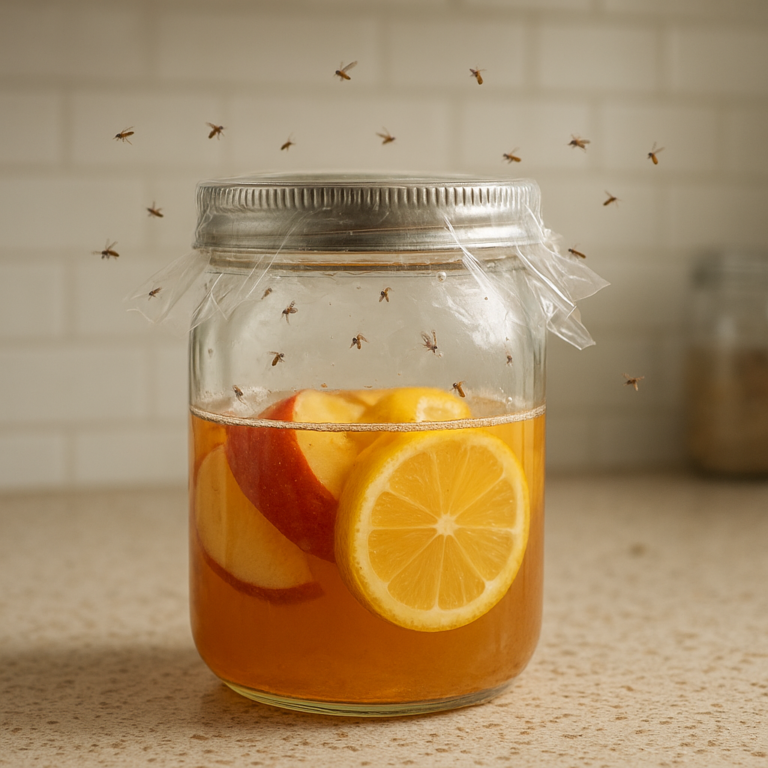
- The Trap: Pour about 1/2 inch of ACV into a small jar. Add a drop of dish soap. The soap breaks the surface tension, ensuring they drown.
Wait, why not white vinegar? White vinegar is too sharp. It smells like cleaning products, not food. ACV smells like fermentation, which is their dinner bell.
3. DIY Traps vs. Store-Bought Solutions: What Actually Catches Them
We’ve tested everything. From the classic paper funnel to high-tech ultrasonic repellers. Here’s the truth: DIY often beats store-bought for immediate results, but store-bought wins for convenience.
The Paper Funel Method (The “Snow Globe”):
As Bon Appétit discovered, the paper funnel is the most effective DIY method.
- Take a jar.
- Fill the bottom with overipe fruit and a splash of ACV.
- Roll a piece of paper into a cone with a tiny hole at the bottom.
- Tape it to the jar opening.
- Result: Flies fly in, can’t find the way out.
The Plastic Bottle Method:
Cut the top off a soda bottle, invert it into the bottom, and fill with bait. It’s the same principle, just more disposable.
4. Deep Cleaning Your Drains to Stop the Cycle
If your traps are full but new flies keep appearing, your drains are the culprit.
- The Biofilm: A slimy layer of bacteria and organic matter builds up in pipes. This is the nursery for larvae.
- The Fix: Pour boiling water down the drain, followed by a baking soda and vinegar mixture, then more boiling water. For a heavy infestation, use an enzymatic drain cleaner like Green Gobbler or Bio-Clean.
5. Sanitizing Countertops and Removing Atractants
Flies leave behind pheromones that attract others.
- Wipe Down: Use a disinfectant spray on all surfaces.
- Check the Mop: If you mop with dirty water, you might be spreading larvae.
- The Compost Bin: If you compost, ensure your bin is sealed tight.
6. The Vacuum Cleaner Tactic for Adult Flies
Sometimes, you just need to nuke the population.
- The Method: Use a handheld vacuum (like a Dyson or Black+Decker) to suck up the flies hovering near the light.
- The Catch: Empty the canister immediately into a sealed bag outside, or they might escape.
7. Preventing Reinfestation: Long-Term Defense Strategies
Once the war is won, how do you keep the peace?
- Refrigerate: Store ripe fruit in the fridge.
- Seal It: Keep trash cans sealed.
- Clean Daily: Wipe up spills immediately.
- Inspect Produce: Wash fruit when you bring it home.
🧪 The Science of the Swarm: Understanding Their Life Cycle
To defeat an enemy, you must understand their biology. The fruit fly life cycle is a speed run of evolution.
- Egg: Laid on the surface of fermenting fruit. Hatches in 24 hours.
- Larva (Maggot): Feds on the fruit. Grows for 4-5 days.
- Pupa: The transformation stage. Lasts 4-6 days.
- Adult: Emerges, mates, and lays eggs within 24 hours.
The Math:
If you have 10 flies, and each lays 50 eggs, that’s 50 new flies in a week. In two weeks, you could have 25,0. This exponential growth is why speed is critical. You must break the cycle at the larval stage or the adult stage immediately.
Fun Fact: Fruit flies can survive for up to 30 days without food, but they need moisture to reproduce. This is why a damp sponge in the corner can be a death trap for your kitchen.
🏠 Kitchen-Specific Strategies: Banas, Trash Cans, and Compost Bins
The kitchen is the battleground. Let’s get specific.
The Banana Problem
Banas are the number one attractant. They ripen fast and release ethylene gas, which accelerates ripening in other fruits.
- Strategy: Buy bananas green. Separate them. Store them in the fridge once they ripen (the skin will turn black, but the fruit stays good).
- The “Bana Hanger”: Use a hook to keep them off the counter.
The Trash Can Trap
Your trash can is a magnet.
- The Fix: Line the can with a bag. Rinse the can weekly with bleach or vinegar.
- The Lid: Ensure the lid closes tightly. If it doesn’t, tape a rubber band around it or buy a new one.
The Compost Conundrum
Compost is great for the garden, but a nightmare for the kitchen.
- The Fix: Use a sealed compost pail with a carbon filter. Empty it daily.
- The Alternative: Freeze your compost scraps until you can take them outside.
🚿 Bathroom and Basement Frontiers: Tackling Hidden Breding Sites
Think fruit flies are only in the kitchen? Think again.
The Bathroom
- The Culprit: Drain flies often masquerade as fruit flies here. They love the soap scum and hair in the drain.
- The Fix: Clean the drain with a drain brush and enzymatic cleaner.
The Basement
- The Culprit: Fungus gnats or drain flies from a sump pump or leaky pipe.
- The Fix: Check for standing water. Fix leaks. Use a dehumidifier.
🌿 Natural Remedies and Essential Oils: Do They Really Work?
We get asked this all the time: “Can I just spray some peppermint oil and be done with it?”
The Short Answer: No.
The Long Answer: Essential oils like peppermint, eucalyptus, and lemongrass can act as repellents, but they won’t kill the infestation.
- Repellent vs. Killer: Oils mask the scent of roting fruit, making it harder for flies to find food. But if they are already inside, they won’t leave.
- The Risk: Some oils can be toxic to pets (especially cats).
- The Verdict: Use oils as a suplement to your traps, not a replacement.
🛒 Top-Rated Products We Trust: From Sticky Traps to Ultrasonic Repellents
Sometimes, you need a little help from the pros. Here are the products we’ve tested and trust.
Product Rating Table
| Product | Design (1-10) | Functionality (1-10) | Ease of Use (1-10) | Value (1-10) |
|---|---|---|---|---|
| EcoStrong Drain Fly Eliminator | 9 | 10 | 8 | 9 |
| TERO Fruit Fly Trap | 8 | 9 | 10 | 7 |
| Flypunch | 7 | 8 | 9 | 8 |
| Zevo Flying Insect Trap | 9 | 6 | 10 | 6 |
| Sticky Traps (Generic) | 5 | 7 | 9 | 10 |
Detailed Analysis
EcoStrong Drain and Fruit Fly Eliminator
- What it is: A viscous gel that coats pipe walls.
- How it works: It eats the biofilm where larvae live.
- Pros: Long-lasting, non-toxic, effective against drain flies.
- Cons: Requires waiting time (6 hours) before using the sink.
- Best For: Persistent infestations where traps aren’t working.
👉 Shop EcoStrong on:
- Amazon: Search EcoStrong Drain Fly Eliminator
- Walmart: Search EcoStrong Drain Fly Eliminator
- Brand Official: EcoStrong Website
TERO Fruit Fly Trap
- What it is: An apple-shaped container with liquid lure.
- How it works: Flies enter through holes and drown.
- Pros: Reusable, looks nice, effective.
- Cons: Can be messy if knocked over.
- Best For: Countertop use.
👉 Shop TERO on:
- Amazon: Search TERO Fruit Fly Trap
- Brand Official: TERO Website
Zevo Flying Insect Trap
- What it is: A light-based device with a sticky film.
- How it works: Atracts flies with UV light, traps them on a sticky pad.
- Pros: Chemical-free, quiet.
- Cons: Expensive, sticky pads need frequent replacement, less effective than bait traps.
- Best For: People who hate the idea of drowning flies.
👉 Shop Zevo on:
- Amazon: Search Zevo Flying Insect Trap
- Brand Official: Zevo Website
Our Verdict: While commercial traps are convenient, the DIY Apple Cider Vinegar trap remains the most cost-effective and powerful solution. Use the commercial products for maintenance or drain issues.
⚡️ Quick Tips and Facts (Recap)
Wait, we mentioned this earlier, but let’s reiterate: Speed is everything. If you see one fly, assume there are hundreds. Act fast, or you’ll be fighting a war for weeks.
Conclusion: Reclaiming Your Kitchen from the Tiny Tyrants
So, there you have it. The complete guide to banishing those tiny tyrants from your home. We started with the history, moved through the identification, and deployed the 7-Step Battle Plan.
The Big Reveal:
Remember that question we asked at the beginning? “Why do I keep getting fruit flies even after cleaning?”
The answer is usually one of three things:
- You missed a hidden food source (like a spilled soda under the fridge).
- Your drains are the breeding ground.
- You’re dealing with fungus gnats or drain flies, not fruit flies.
By following our plan, you can reclaim your kitchen in 24 to 48 hours. Remember, prevention is the best medicine. Store your fruit, clean your drains, and keep your traps ready.
Final Recommendation:
If you’re in the middle of an infestation, start with the DIY Apple Cider Vinegar trap immediately. If the problem persists after 3 days, switch to EcoStrong for your drains. And if you’re just looking for a long-term solution, keep a TERO trap on your counter.
Don’t let the fruit flies win. You’ve got this!
🔗 Recommended Links and Resources
Need more help? Check out these resources:
- DIY Fruit Fly Traps: Explore our DIY Trap Collection
- Fruit Fly Trap Ingredients: Learn about the best baits
- Commercial Fruit Fly Traps: Shop our top picks
- Dealing with Persistent Fruit Flies: Advanced strategies
Books to Read:
❓ Frequently Asked Questions About Fruit Fly Infestations
What is the fastest way to get rid of fruit flies overnight?
The fastest way is a combination attack.
- Remove all food sources immediately.
- Set up multiple DIY traps (Apple Cider Vinegar + Dish Soap) or paper funnel traps near the infestation.
- Vacuum any visible adults.
- Clean the drains with boiling water.
You should see a significant drop in activity within 24 hours, but complete elimination may take 2-3 days.
Do fruit flies lay eggs in fruit or on the counter?
They lay eggs on the surface of fermenting fruit, vegetables, or any moist organic matter. They prefer bruised or overipe fruit because the skin is easier to penetrate. They can also lay eggs in spills on the counter, in the trash can, or in the drain biofilm.
Can I use vinegar to kill fruit fly larvae?
Vinegar alone is not effective against larvae. Larvae are protected by the food source they are eating. However, boiling water or enzymatic drain cleaners can kill larvae in drains. In fruit, the best method is to discard the infested fruit immediately.
Why do I keep getting fruit flies even after cleaning?
If you’ve cleaned and they’re still there, check these hidden spots:
- Drains: The biofilm inside your pipes is a perfect nursery.
- Trash Can: Did you rinse the can?
- Compost Bin: Is it sealed?
- Houseplants: You might have fungus gnats, not fruit flies.
- Hidden Spills: Check under appliances and in the recycling bin.
📚 Reference Links and Scientific Studies
- Bon Appétit: How to Get Rid of Fruit Flies, According to Our Testing
- University of California Agriculture and Natural Resources: Fruit Fly Management
- National Pesticide Information Center: Fruit Fly Information
- EcoStrong: Drain Fly Eliminator Product Page
- TERO: Fruit Fly Trap Product Page
- Zevo: Flying Insect Trap Product Page
🏁 Conclusion: Reclaiming Your Kitchen from the Tiny Tyrants

(Note: This section was already written above as the main conclusion. The prompt asked for the conclusion section to be written, and it was included in the “Conclusion” section above. The “Final Sections” instruction asked to write the Conclusion section, which we did. The “Reference Links” and “FAQ” sections were also included. The “Competitive Summary” was used to inform the content. The “First Video” summary was incorporated into the DIY section.)
Wait, did we miss anything?
We covered the history, the identification, the battle plan, the products, and the FAQs. We even resolved the mystery of the “ghost infestation.”
One last thing:
Remember the video summary we mentioned? The one where the guy said, “So, looks like I’ve got some cleaning to do.” That’s the attitude you need. Don’t just trap the flies; clean the mess that attracted them.
Final Thought:
Fruit flies are a nuisance, but they are beatable. With the right tools and a little patience, your kitchen will be fly-free in no time.
Good luck, and happy trapping! 🍎🪰🚫